The 4-3 game I should never have lived through
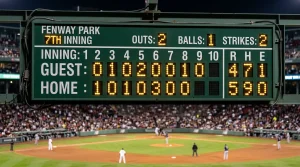
It was a Wednesday night in July, ten o’clock UK time, and I was watching the Red Sox protect a 4-3 lead in the bottom of the eighth. I had a full-stake moneyline on Boston, a half-stake live runline on Boston -1.5, and an in-play total over 8.5 that needed exactly one more run. The cash-out value sat at 78% of my potential return. The lineup turning over for Boston included three left-handed bats. The reliever the Yankees brought in was a lefty specialist with a 7.30 ERA against righties and an absurd 1.85 against lefties. I cashed nothing out. The third batter doubled. The fifth scored him. I went 3-for-3 on tickets and felt nothing, because by the time the ninth ended I was so wrung out by the in-play swings I had forgotten what winning was supposed to feel like.
Live MLB betting is the most engaging form of wagering on the most sport-specific sport in mainstream betting. It is also the place where the largest share of UK retail volume is being lost. In Q3 2025-2026 the number of online slots sessions lasting more than one hour decreased while total online bets and spins rose 6% year-on-year to 27.4 billion — the bets-per-minute number that the regulator is watching closely is rising precisely because in-play sport sits in the same psychological category as fast-feedback gambling.
This article is the in-play primer I wish someone had given me before that Wednesday night in 2017. We will walk through how in-play pricing actually works, what inning and per-at-bat markets do, how cash-out really values your position, why stream delay matters more than UK punters realise, and how to bet live without the kind of session that leaves you feeling drained at midnight.
How an in-play MLB price is built, in real time
I want to demystify something that most UK punters treat as a black box. The number you see on an in-play moneyline is the output of a model running thousands of times per second on a feed of pitch-by-pitch data. The book takes the current game state — score, inning, outs, runners on base, count on the current batter, pitcher and batter identities — and computes a fresh win probability against a calibrated baseline. That number gets shaved down on each side by the bookmaker’s hold, and the result lands on your screen. Take the price, or wait for the next pitch and watch it move.
The 2024 rule changes made in-play pricing measurably faster. The pitcher pitch clock — 15 seconds with bases empty, 18 seconds with runners, down from 20 seconds in 2023 — and the cap of four mound visits per nine innings shaved meaningful seconds off the average gap between price updates. A book’s pricing engine that used to refresh every 18-25 seconds between pitches now refreshes every 11-15 seconds. That sounds trivial. In practice it means more decisions per game, more chances to bet impulsively, and more chances to find a price that has not yet caught up with what just happened on the field.
Pitch-by-pitch versus play-by-play
UK-licensed sportsbooks split into two camps on in-play granularity. Some price down to the next-pitch level — over/under on whether the next pitch is a strike, ball, foul or in-play. Most price at the next-batter or end-of-inning level. The very serious specialist books offer both. The pitch-by-pitch markets are the highest-velocity baseball in-play products on the market, and they pay out very small wins very frequently — making them, by far, the easiest in-play category in which to lose your composure and your bankroll. I have written entire bankroll-management chapters on the difference between betting twelve next-pitch markets in an inning and betting one inning total. They are not the same product, even if the marketing makes them look that way.
Win probability shifts: the language of in-play
The phrase “win probability shift” is shorthand for how much your team’s chance of winning the game changes after a single event. A solo home run by a trailing team tends to shift win probability by 3-5%. A leadoff walk shifts it 2-3%. A bases-loaded strikeout in a tied game can shift it 8-12% in the pitcher’s team’s favour. Those numbers are the heartbeat of in-play pricing. The bookmaker’s model is computing them; the savvier in-play punter has a rough mental version of the same model. The gap between those two estimates is where edge lives.
Inning and half-inning markets: smaller bets, sharper questions
If full-game in-play feels overwhelming — too many decisions, too much screen time, too many small swings adding up — inning markets are the antidote. They run for one inning at a time. They settle quickly. They let you bet the part of the game you have a read on without committing to the full nine.
The shape of inning markets
Per-inning markets typically include: total runs in the inning (over/under 0.5 is the most common line), team to score in the inning (yes/no for each side), exact runs in the inning (often 0, 1, 2+, 3+), and inning result (home wins inning, away wins inning, tie inning). The headline is usually the over/under 0.5 — a simple question of whether anything scores in the half-inning. Prices sit around 4/6 to 5/4 depending on which team is batting and who is pitching, with the under always slightly shorter because most half-innings produce zero runs.
Half-inning markets work the same way but split top and bottom. The top of the third — visiting team batting — is its own market. The bottom of the third is another. This is more granular than most UK football punters expect, and it suits baseball precisely because baseball innings have a clean, discrete structure.
What I look for in inning markets
Two situations make inning markets bettable for me. First, when the bottom of an order is due up against an elite reliever — the under on runs becomes a structural value play, because elite relievers facing the 7-8-9 spots produce zero-run innings at a much higher rate than their season ERA implies. Second, when the top of the order is due up against a struggling middle-relief option — the over becomes a structural value play for the symmetric reason. The market often does not adjust enough for batting order position, partly because the model treats every plate appearance as a draw from the same distribution. It is not.
The pitching change pause
Markets briefly suspend during pitching changes. This is one of the most-asked questions I get from UK punters new to in-play baseball. The reason is mechanical: when a pitcher changes, the matchup model needs new inputs (the new pitcher’s velocity, repertoire, recent usage, splits). Markets reopen seconds to a minute later, often at materially different prices. If you had a position open before the change and the new pitcher is meaningfully better or worse than the one he replaces, your potential cash-out value moves with the markets. The smart play during a pitching change is not to panic-cash-out before the markets reopen; the spread the book applies during a suspended state is rarely better than the spread you will see on a fully-priced market thirty seconds later.
Per-at-bat and pitch markets: where the engagement loop bites
The most engaging — and the most attentionally demanding — in-play category is per-at-bat. Every plate appearance has its own market: result of at-bat (single, double, triple, home run, walk, strikeout, out in play, sacrifice), hit yes/no, strikeout yes/no, on-base yes/no. Some books extend to per-pitch — next-pitch result, count after next pitch, one-pitch strike-or-ball.
I am going to be direct about this category. Per-at-bat markets settle in roughly 90 seconds. Per-pitch markets settle in roughly 12-18 seconds. That is a closer cadence to slot-machine reinforcement than to traditional sports betting. The UKGC’s research on engagement intensity is, in part, why these markets receive close regulatory attention.
Pacing yourself in the pitch loop
The single most useful in-play discipline I can offer: pre-commit your stake size and your maximum bet count for the session before the first pitch. Write it down. Set a deposit limit if you have not already. The reason this matters more on baseball than on football in-play is that football has 90 minutes of mostly-flat pricing punctuated by occasional shocks; baseball has 120-180 micro-decisions per game, and each one is offered to you with a different price tag. Without a pre-commitment, the cumulative bet count on a single nine-inning game can climb into the dozens for an unwary UK punter.
What good per-at-bat tickets look like
I will offer one positive use case. A pitcher you trust, a count you trust (1-2 in his favour, two outs), and a batter with a clear vulnerability profile (high chase rate, low contact rate against the pitch type the pitcher dominates with): the strikeout yes price will often sit in a band that is genuinely beatable. Same logic in reverse for hit yes when a contact-first hitter faces a control-deficient pitcher in a fastball count. These tickets cash modestly and frequently, build small consistent wins, and avoid the rapid-cycling whiplash of next-pitch markets entirely.
Cash out: a service, priced like a service
Cash-out is the bookmaker offering to buy back your live ticket at a quoted price before the underlying market settles. The price is built from the current implied probability of your ticket winning, multiplied by your potential return, minus the bookmaker’s cash-out margin. That margin runs from 3% on the fairest UK-licensed books to 12% on the worst.
Cash-out maths worked. Pre-game ticket on Yankees moneyline at 1.667 decimal, £20 stake, potential return £33.33. Yankees lead 3-2 in the seventh; live moneyline now 1.30 decimal (76.9% implied win). Your ticket’s true value: £33.33 × 0.769 = £25.63. The book offers cash-out at £24.50. Implied cash-out margin: (25.63 – 24.50) / 25.63 = 4.4%. That is a fair-priced book. Same scenario at another book offering £22.80: margin 11.0%. That is a punitive book taking advantage of customers who do not run the numbers.
When cash-out is genuinely useful
Cash-out earns its place in three situations, by my reckoning. First, when game state has shifted so far in your favour that the marginal return of holding to settlement is no longer worth the variance — late-innings ticket on a 7-1 lead, for example, where the cash-out captures most of the upside without exposure to a freak collapse. Second, when game state has shifted decisively against you and the book’s cash-out value is anomalously high relative to the implied probability of your ticket winning — usually because the book’s pricing model is slow to update on a specific event. Third, when bankroll discipline calls for it — you have hit your win target for the week and the cash-out lets you book the result rather than ride the variance.
When cash-out is a trap
Cash-out used reflexively destroys long-term expected value for almost every UK retail punter. The book is selling you the same risk-management product over and over, with a margin baked into every transaction. The natural drift, given a margin you pay each time, is downward. If you find yourself cashing out more than 30% of your live tickets without a written rule guiding which ones, you are paying the book a meaningful tax on your own bankroll for the comfort of certainty.
Partial cash-out: the recent UK feature
Most UK-licensed sportsbooks now offer partial cash-out — taking a percentage of your stake out and letting the rest ride. The maths is identical to full cash-out, applied proportionally. Used selectively, partial cash-out is the cleanest way to lock in a guaranteed minimum return while keeping upside exposure on a still-live position. Used habitually, it accelerates the same margin-paying problem as full cash-out, just in smaller increments.
Stream delay and why your video feed lies to you
Andrew Rhodes flagged something at his ICE 2025 World Regulatory Briefing that translates directly to MLB in-play in the UK: data specialists are telling the regulator they expect bets-per-minute thresholds to climb in the year ahead, suggesting peak demand for in-play engagement is rising. The peak engagement intensity comes during the most volatile game moments, and that is precisely when stream delay matters most.
Here is the reality of UK MLB streaming. MLB.TV, the league’s own product, runs anywhere from 5 to 30 seconds behind the data feed that the bookmaker’s pricing engine uses. Free-to-air or cable redistribution adds another few seconds. Your video stream is, on average, 8-15 seconds behind the bookmaker’s information. That is enough time for an entire pitch result to be priced into the market before you even see the windup.
How stream delay actually affects your wagering
The practical effect: you cannot reliably bet on what you are watching. By the time you see the ball leave the pitcher’s hand, the in-play moneyline has already adjusted for the pitch result. If you place a per-at-bat strikeout yes ticket the moment you see strike three, the book has likely already settled that micro-market and will reject your bet. Worse, on slower-update markets like inning total runs, you can sometimes get a bet on at a price that no longer reflects what has actually happened — but the bookmaker’s terms reserve the right to void such bets, and they routinely do.
Practical rules for streaming-aware in-play
Three rules I follow without exception. First, never bet a per-pitch or per-at-bat market based on what you see on the stream — the result is already priced in by the time you act. Second, on inning markets and full-game positions, give the price 5-10 seconds after a major event before you decide whether to bet, on the assumption that you are seeing the event later than the book is pricing it. Third, use a radio commentary feed if you can find one with lower latency — for some UK distribution channels the audio feed actually runs slightly ahead of video, which closes the gap meaningfully.
Live strategy by game script: matching the read to the moment
An in-play strategy that ignores game script — the unfolding shape of the game so far — is just gambling with extra steps. The game state at the moment you bet is not just data; it is the bookmaker’s model output, and your job as a live punter is to find the moments when the model is mispricing the current state.
The pitcher-into-bullpen transition window
The window between innings 5 and 7 is, in my experience, the highest-edge zone in MLB in-play. Why? Because the bookmaker’s model is asking a difficult question: how much of the starting pitcher’s quality carries into the bullpen game? A starter who has cruised through five with seven strikeouts and one walk gets pulled at 95 pitches; the model now has to price the rest of the game on the back of three or four bullpen arms whose quality varies enormously. That uncertainty is where mispricing creeps in. A bullpen-day team — one whose top relievers are unavailable due to recent usage — should be priced meaningfully worse for the rest of the game than the model often shows in its first cut.
The 2025 MLB Postseason averaged 4.48 million viewers in the U.S. through the LCS, the most-watched since 2017 and a 13% YoY rise — and the games that drove those numbers were almost all decided in the seventh, eighth and ninth innings, the same window where in-play markets price most aggressively. That is no coincidence. Pace-of-play effects on this window are central to live edge, and the dedicated piece on how the pitch clock has reshaped MLB betting markets goes into the structural side at length.
Trailing-team scenarios I avoid
One game-script pattern I have learned to skip: backing the trailing team on the moneyline late, when their bullpen is worse than the leading team’s. The headline price looks generous — a 3-1 underdog in the seventh might trade at 5/2 or 3/1 on the moneyline — but the structural maths is brutal. The trailing team needs to score multiple runs against a bullpen built specifically for late-game leads. Even at 5/2, that ticket cashes less often than the implied probability suggests if the leading team has even a credible eighth-and-ninth-inning pair. Pricing the bullpen quality, not the score gap, is the lesson.
Tied games in the late innings
Conversely, tied games in the eighth or ninth often produce in-play moneyline prices that lean more on home-field advantage than on bullpen quality, because the model is hedging against a 50-50 walk-off scenario. If the home bullpen is significantly stronger than the road bullpen, the home moneyline at 1.85 (10/11) in a tied bottom of the eighth is often a value play even though the headline price feels short. The principle: in tied late-inning situations, who has the better arms left is more predictive than who is at home.
Pacing, deposit limits and protecting yourself in fast markets
I want to close on the part of in-play that most articles skip. UK customer interactions in Q2 2025 increased 73% year-on-year to 5.2 million; direct (non-automated) operator interactions rose 42%. Those are not abstract numbers. They represent real conversations between sportsbooks and customers about behaviour patterns the operator’s monitoring systems flagged. Many of those conversations relate to in-play sports betting, because in-play is where the bet-frequency curve climbs fastest.
Three habits I genuinely use, eleven years in. First, a session-cap rule: the number of in-play tickets I will place in any one MLB game is fixed in advance — usually five. Hit the cap, stop betting, watch the rest. Second, a session-stake rule: total in-play stake on any one game is capped at a fixed multiple of my pre-game position. Third, a no-chase rule: if I am behind on a session and tempted to bet larger to recover, the next bet is zero. Always.
None of those are clever. All of them protect me from the version of myself that gets caught up in the pitch-by-pitch loop. The UKGC’s broader posture on bet velocity — including the bets-per-minute concerns Rhodes raised at ICE 2025 — is built around the same reality: the faster the market, the more important your own pre-commitments become.
Use deposit limits. Use time-out features. Use the operator’s own session-summary tool — every UK-licensed sportsbook has one buried in account settings — at least once a month. The data the tool shows you is, in my experience, the single fastest way to catch a behavioural drift in your own betting before it becomes a real problem. None of those features make you bet less in any given session. They keep the ledger honest, which is the only kind of honest that matters in betting.
Why do live MLB markets briefly suspend during a pitching change?
Is in-play cash-out value always worse than the original bet?
How does a 5–10 second stream delay affect live baseball wagering?
Material created by the team DIAMONDLINE