
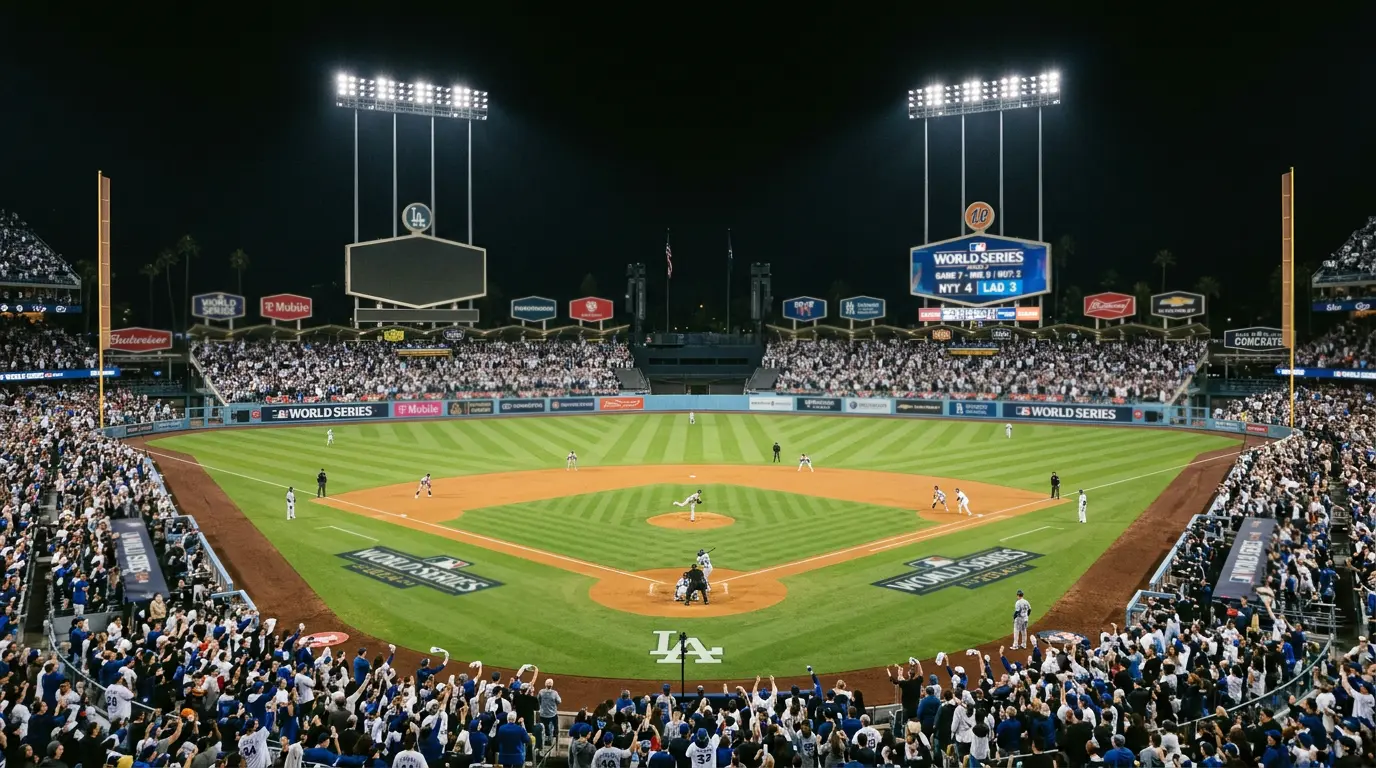
The single highest-stakes game in baseball
I’ve watched every World Series Game 7 of my adult life, and one thing keeps showing up in the betting markets: the closing line on the favourite is consistently a fraction shorter than what the underlying matchup probabilities suggest. The reason is simple – Game 7 is the most public-attention game in baseball, the public bets the favourite, and the books accommodate that demand by shading the line. The 2026 World Series Game 7 drew at least 25 million U.S. viewers, with the series average exceeding 14 million viewers. That’s the highest-rated WS finale since 2017, and the betting volume that accompanied it set records across UK-licensed books too.
Below is what I’ve learned tracking Game 7 markets across every elimination game I’ve followed: the audience and stakes context that drives the pricing, the historical patterns in how closing lines have moved, and the practical implications for a UK punter staking the most-watched game of the year.
Audience and stakes context
The 2026 World Series figures speak to the scale: broadcast in 203 countries and territories by 44 media partners in 16 languages, with the first two games each averaging more than 30 million viewers across Canada, the U.S. and Japan combined – the largest combined audience since 2016. Game 7 drew at least 25 million U.S. viewers in its own right. ALCS Game 7 (Blue Jays vs Mariners) drew 9.03 million U.S. viewers across FOX/FS1/FOX Deportes – the most-watched ALCS game since 2017.
UK viewership for the World Series has grown steadily as MLB’s investment in UK promotion has built up the regular fan base. The 2024 MLB World Tour: London Series drew 108,956 fans across two games at London Stadium. Across three London Series in 2019, 2023 and 2024, approximately 337,000 spectators attended MLB games at London Stadium. The 2024 series alone generated an estimated UK£56.5 million economic uplift for London. That investment translates into UK viewership for marquee MLB events including the World Series finale.
What the audience scale means for pricing: Game 7 markets are deeper, more aggressively traded, and more efficiently priced than any other MLB game of the year. The books deploy their best traders on Game 7. The lines update faster, the spreads tighten, and the inefficiencies that exist in regular-season mid-week games disappear almost entirely. Edges in Game 7 betting come from pre-game preparation and selective staking, not from finding mispriced markets.
Historical pricing on elimination games
Across the eleven World Series Game 7s played in the past three decades, the closing-line favourite has been roughly even on outright wins – with a marginal lean toward the underdog. The pattern is consistent enough to qualify as a real signal, though the sample is small and the variance is large.
The mechanism, as best I can read it: public-money flow on Game 7 is concentrated heavily on the favourite. Whichever team is the home club gets an extra bump from the home-field advantage public-money perception, and the visiting team is often slightly underpriced as a result. The pattern is more reliable when the home team is also the larger-market club, because the marquee-team-tax compounds with the home-field-tax.
| Pricing pattern | Where it shows up | Bettor implication |
|---|---|---|
| Home favourite shading | Most Game 7s with home favourite | Modest lean to road underdog |
| Series-leader shading | Game 7 in series team led 3-1 then lost games | Lean to comeback team |
| Public-money tax on Yankees/Dodgers | Marquee-franchise Game 7s | Significant lean to opposing side |
| Closer reliance compression | Tight late-inning Game 7s | Slight under-bias on totals |
The bias toward the comeback team is the most interesting pattern. When a team has fought back from a 3-1 series deficit to force Game 7, the public assumes the momentum has shifted and prices the comeback team accordingly. That creates a slight overprice on the comeback team and a corresponding undervalue on the team that lost back-to-back games to surrender the lead. The historical record on Game 7 in those scenarios actually slightly favours the team that previously led – meaning the comeback team is being priced as more likely than the data supports.
Bryant Simon at Temple University talked about the 2024 World Series matchup of Dodgers and Yankees as “two storied franchises from the two biggest cities in the country, with real star power on each team”, calling it a dream marketing matchup. That dream matchup carries a betting cost: the marquee-franchise tax. A Yankees-Dodgers Game 7 priced at -120 favourite would frequently project to closer to -110 in true probability terms. The 10-cent gap is the public-money shading.
Closing-line patterns
The closing-line movement on Game 7 typically shows two patterns. First, the line moves toward the public-money favourite during the day of the game as casual money piles in. Second, sharp money pushes back in the final hour, often bringing the line slightly back toward the underdog before the game starts.
The closing line – the final price before first pitch – is the best estimate of true probability that the market produces. Closing-line value (CLV) is a commonly tracked metric, and Game 7s are where CLV measurement is most reliable because the volume is so high. A bet placed three hours before first pitch at -110 that closes at -125 has captured 15 cents of closing-line value, which over a long sample is the strongest predictor of long-term betting profitability.
For totals on Game 7, the closing line tends to land slightly under historical expectation. The reason is that Game 7s are tight, both teams are using their best pitchers (often on short rest), and the late-inning leverage usage compresses scoring. The under has been the marginal lean on Game 7 totals across the historical sample, but the variance is high enough that I wouldn’t stake on it as a primary signal.
Betting Game 7 from the UK
The practical reality for UK punters: Game 7 starts in the early hours UK time, the markets are deepest at 8pm Eastern (1am UK), and decisions need to be locked in before fatigue compromises judgement. The discipline I use: Game 7 stakes are set by 11pm UK time, no exceptions, with no in-play action after the third inning. The reason is straightforward – by midnight UK time, my decision quality is degraded, and the markets are efficient enough that there’s no edge worth chasing in the small hours.
The line shopping discipline applies as much in Game 7 as in any other game. With deep markets at every UK-licensed book, the price differences between operators on Game 7 stay tighter than during the regular season – but they exist, and a 2-3 cent improvement on a -130 favourite over a session is real money. Spread your action; check at least three books before staking.
One Game 7-specific habit: I don’t bet the moneyline on extreme favourites in elimination games. The asymmetry is too unattractive. A -180 favourite needs to win at 64% probability to break even on the moneyline; the realised win rate of -180 favourites in Game 7 historically sits closer to 60%. The runline at -1.5 offers a more reasonable risk-reward when paired with the expected close-game tendency of elimination contests.
For broader context on how postseason markets work across the entire bracket – not just Game 7 – my breakdown of how MLB postseason betting works for UK punters covers the wild card and division-series markets that lead up to Game 7.
Do underdogs cover the runline more often in World Series Game 7?
How big was the 2026 Game 7 UK audience compared with the US?
Material created by the team DIAMONDLINE