Why Yankees lines feel more expensive than they should
Bryant Simon, the historian at Temple University, made a remark in spring 2026 that stuck with me: when Dodgers and Yankees are both winning, you have a level of star power that makes the sport feel different from anything else. He was talking about cultural reach. I was thinking about the betting line.
The Yankees are a public team. Always have been, probably always will be. UK punters who came to baseball through Yankees highlight reels – and that’s most of us, honestly – tend to back them at prices that don’t quite reflect the underlying game. The 2026 postseason drew 4.48 million US viewers on average, the league’s best in seven years, and a healthy slice of that audience was watching pinstripes. That same audience is at the betting window the next morning, and the books know it.
This article is about how to bet the Yankees from the UK without paying the public-money tax. We’ll walk through why their prices skew, how Yankee Stadium itself shapes totals and props, where the prop markets are richer than the moneyline, and how to think about division and pennant futures across a long season.
Why Yankees prices skew on UK books
UK-licensed sportsbooks operate in a global pricing environment, but they take action from a UK-heavy book that’s biased toward the most internationally recognisable MLB clubs. The Yankees, the Red Sox, the Dodgers and the Mets carry a public-money premium on most UK books most of the time. The Yankees premium is the steepest.
What that looks like at the window: a Yankees moneyline that should be -160 by the underlying game model often opens at -175 and gets bet to -180 or -185 by first pitch on a typical Tuesday night. That’s a six-to-ten cent difference per side, which is substantial on a season’s worth of action. The UK sports betting market is projected to grow from USD 11.24 billion in 2024 to over USD 21 billion by 2030 at a compound annual growth rate above 11%, and online accounts for nearly four-fifths of that. More volume on the public side means more sustained pressure on the price.
Where the bias really shows is on road games. A Yankees home favourite is mispriced by less because the home edge is genuine and absorbs some of the public premium. A Yankees road favourite at -130 against a competent National League opponent is often the better moneyline target for the opposing side, because the public-money tax pushes the Yankees from a fair -120 to a sticky -130 or -135. Road-favourite plus-runline tickets on the home dog have been one of my more consistent angles when the matchup isn’t a clear talent mismatch.
Public-money pressure also shows up in prop markets – Aaron Judge home run yes/no opens at prices that bake in heavy public action – but the prop landscape is wide enough that you can usually find at least one or two correlated lines that haven’t been beaten down. We’ll come back to that.
Bronx Bombers park effect
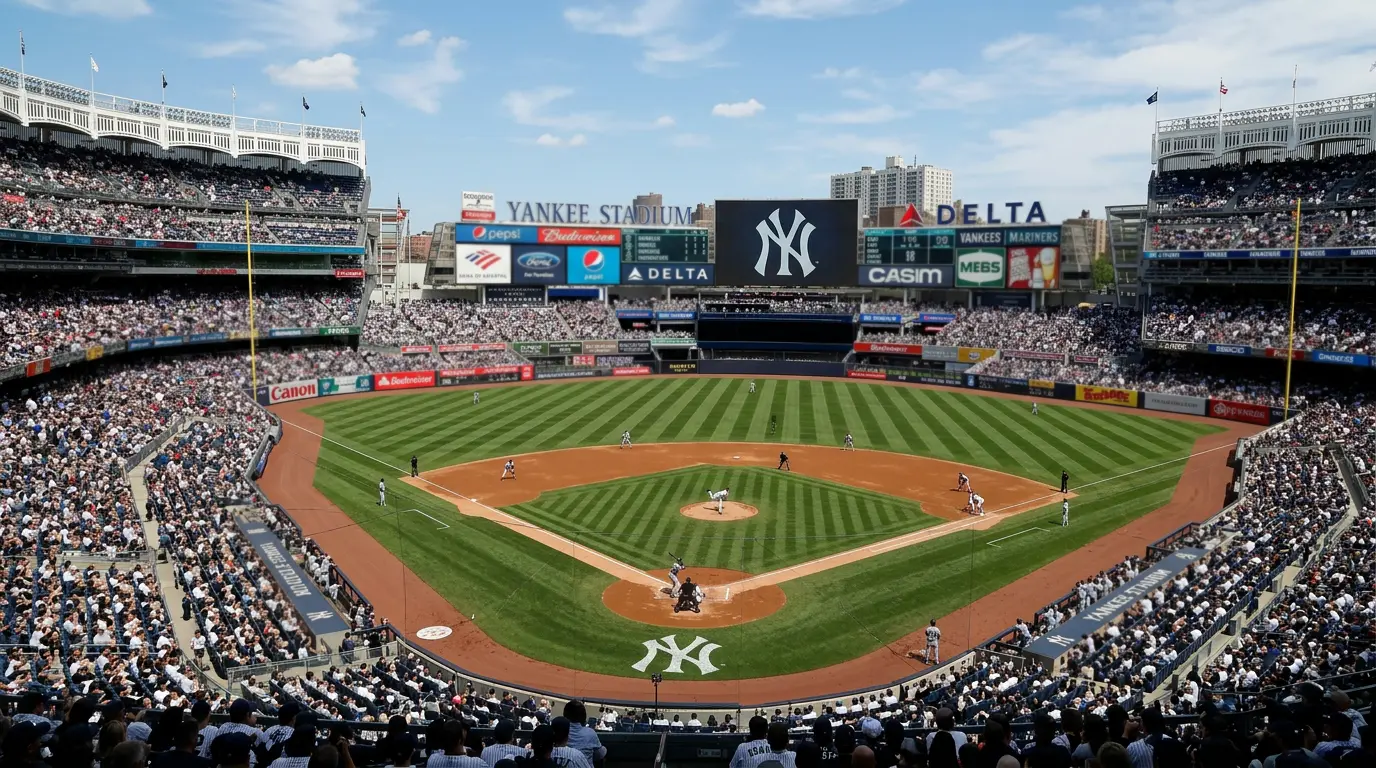
Yankee Stadium is a hitter’s park, full stop. The short right-field porch – 314 feet down the line, with a wall that doesn’t get much taller as you head to right-centre – turns left-handed pull contact into home runs at a rate few other parks can match. Right-handed power plays differently; the left-field dimensions are friendlier than they used to be at the old stadium, but the right-field corner is the headline feature.
For UK punters pricing totals, this means Yankees home games carry an upward bias on over/unders relative to neutral parks. Books typically reflect this with totals running half a run higher at home than the same Yankees lineup would generate on the road. That adjustment is fair on average but uneven game-to-game, particularly when a left-handed-heavy visiting lineup faces a Yankees right-hander who’s prone to giving up fly balls.
The other park-effect angle is wind. Yankee Stadium’s geometry creates wind patterns that swing total runs by half a run when the prevailing direction is out to right. UK books don’t typically incorporate game-day weather into pricing as aggressively as some sharp US books, which is where pre-game value can emerge if you check forecasts an hour before first pitch.
Prop markets on Yankees stars
Prop pricing on the headline Yankees bats is where I think UK punters can do the best work, but the path isn’t always obvious.
Aaron Judge home run props are heavily traded and tightly priced. The “to hit a home run” yes line on Judge in a typical game runs anywhere from +220 to +290 depending on the matchup, and those numbers are usually fair-to-slightly-juiced because volume keeps them honest. The softer angles are total bases over 1.5, walks props, and strikeouts. Judge’s combination of power, plate discipline and contact quality means his secondary stat lines move less efficiently than the home run market.
For starting pitchers in pinstripes, strikeout props are well-priced when the pitcher is a known commodity and softer when a fifth starter or recent call-up takes the mound. Books take a few starts to recalibrate around new arms, and the early data is where alternate strikeout lines occasionally lag behind reality.
The prop market I’d flag most often: hits-allowed unders on the Yankees bullpen on tightly-priced moneyline games. When New York is a heavy home favourite, public action concentrates on the win, the runline and big-name hitter props. The bullpen-strikeout and hits-allowed lines get less attention and are priced more thinly. If you’ve watched the eighth-inning matchup unfold and the right-hander coming in has good numbers against the visiting lefty contingent, that’s a market worth pricing carefully.
Division and pennant futures across a long season
AL East futures on the Yankees are a different beast from game-by-game pricing. The market is liquid, the books take serious action, and the price tends to reflect the consensus more accurately than nightly moneylines do. Pre-season AL East futures on the Yankees usually live between +110 and +180 depending on offseason moves, and that range is roughly fair on average.
Where futures pricing breaks down is mid-season. By late June, books are recalibrating based on first-half performance, but they’re slow to adjust for sustainable underlying metrics versus noisy results. A Yankees club at 42-38 with a positive run differential pricing as a +200 division dog is a different proposition from one at 42-38 with a negative differential and a beat-up rotation.
World Series futures behave similarly. The Yankees opened the 2026 season at long-but-respectable odds to win the pennant. Repeat-favourite pricing on any preseason contender – you can read more in this analysis on betting on the Dodgers from the UK – illustrates how books anchor on the previous season’s narrative arc.
One bankroll note: futures tickets on the Yankees lock up capital. A pre-season +800 ticket sits on your account for seven months. UK punters who back the Yankees in three different long-term markets – division, pennant, World Series – can tie up significant fractions of bankroll that would otherwise be working in higher-velocity game-by-game markets. Size accordingly.
Are Yankees moneyline favourites typically over-priced because of public bias?
Do Yankees road-favourite spots offer the best runline value?
Material created by the team DIAMONDLINE